For much of human history, people made art by trying to represent the world as it appeared around them. Until about 100 years ago, when a bunch of artists stopped trying to do that. It was shocking then and it still upsets and confounds today. How are we supposed to deal with art completely removed from recognizable objects? And why should we? This is the case for Abstraction.
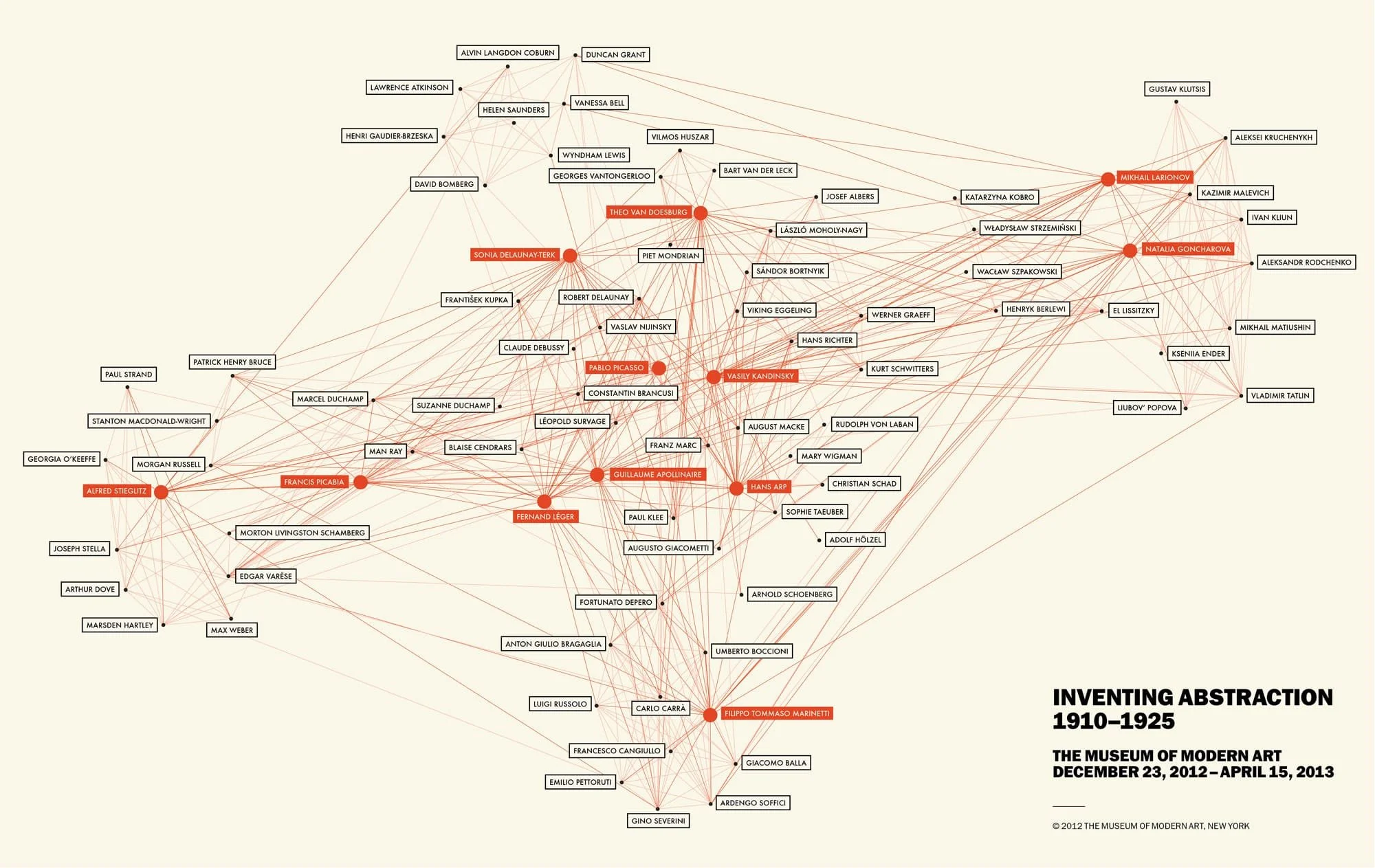
The invention of abstraction was not the inspiration of a solitary protagonist, but a relay of ideas that moved through a network of artists and intellectuals working in different countries and different media. This diagram maps the nexus of relationships among those artists represented in the exhibition Inventing Abstraction: 1910-1925, all of whom played a significant role in the development of a new modern language for the arts. Vectors connect individuals whose acquaintance with one another in the period 1910–1925 could be documented. The names in red represent those figures with the most number of connections within this group. The chart was produced as a collaboration between the exhibition’s curatorial and design team and Paul Ingram, Kravis Professor of Business at the Columbia Business School, and his students.

………………….What is abstract art good for? What's the use--for us as individuals, or for any society--of pictures of nothing, of paintings and sculptures or prints or drawings that do not seem to show anything except themselves?………………..In this invigorating account of abstract art since Jackson Pollock, eminent art historian Kirk Varnedoe, the former chief curator of painting and sculpture at the Museum of Modern Art, asks these and other questions as he frankly confronts the uncertainties we may have about the nonrepresentational art produced in the last five decades. He makes a compelling argument for its history and value, much as E. H. Gombrich tackled representation fifty years ago in Art and Illusion………..With brilliance, passion, and humor, Varnedoe addresses the skeptical attitudes and misunderstandings that we often bring to our experience of abstract art. Resisting grand generalizations, he makes a deliberate and scholarly case for abstraction--showing us that more than just pure looking is necessary to understand the self-made symbolic language of abstract art. Proceeding decade by decade, he brings alive the history and biography that inform the art while also challenging the received wisdom about distinctions between abstraction and representation, modernism and postmodernism, and minimalism and pop………….